














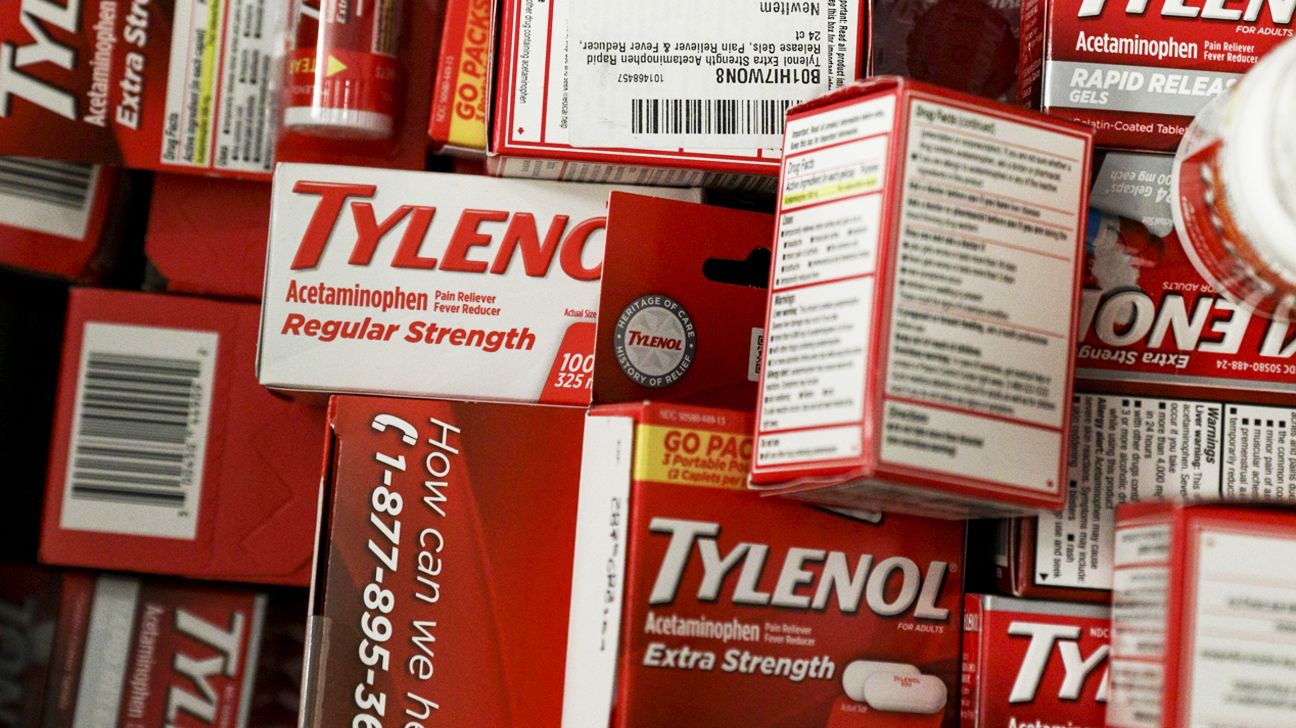
- The Trump administration said the FDA will begin notifying doctors about the possible link between autism and Tylenol during pregnancy.
- The FDA initiated a label change for Tylenol to include mention of the possible associated risks of acetaminophen use during pregnancy and autism and ADHD in children.
- The Tylenol-autism theory is based on a research review that determined an association, but most studies have found no causal link.
- Federal health officials are also expected to recommend leucovorin, a drug used to treat cancer and anemia, as a potential therapy for autistic people.
The Trump administration announced on Monday that the Food and Drug Administration (FDA) will begin notifying physicians that Tylenol use during pregnancy “can be associated with a very increased risk of autism.”
“They are strongly recommending that women limit Tylenol use during pregnancy unless medically necessary,” the president said.
Following the announcement, the
Federal health officials have also highlighted leucovorin as a potential therapy for autism. Leucovorin is a form of folate used in cancer and anemia treatments.
At a memorial service for conservative activist Charlie Kirk in Glendale, AZ, on Sunday, President Trump had teased the autism announcement and told reporters that Tylenol is “a very big factor” driving autism prevalence.
As part of an ongoing effort to address concerns over rising autism rates, Health and Human Services (HHS) Secretary Robert F. Kennedy Jr. had vowed to find the “cause” of autism by September. On Monday, the president thanked the Health Secretary for bringing the issue “to the forefront of American politics,” but did not claim that Tylenol is a definitive cause of autism.
Kennedy has repeatedly criticized childhood vaccines as a cause of autism, a claim that clashes with a scientific consensus showing no such link. When the autism-vaccine link was widely debunked, Kennedy set his sights on a new suspected cause: Tylenol use during pregnancy.
A recent
Following publication of the review, an exclusive in The Wall Street Journal revealed that the HHS, under Kennedy’s direction, would release a report detailing Tylenol as a cause of autism. As a consequence of the WSJ report, the stock for Kenvue, Tylenol’s manufacturer, fell by more than 9%.
Still, the Tylenol-autism theory lacks sufficient high quality scientific evidence, and a majority of studies have found no causal link.
In response to President Trump’s announcement, Tylenol issued a statement on its website asserting that over a decade of rigorous research confirms “there is no credible evidence linking acetaminophen to autism.”
The American College of Obstetricians and Gynecologists (ACOG) has also released a statement reaffirming the safety of acetaminophen use during pregnancy.
“Suggestions that acetaminophen use in pregnancy causes autism are not only highly concerning to clinicians but also irresponsible when considering the harmful and confusing message they send to pregnant patients, including those who may need to rely on this beneficial medicine during pregnancy,” said ACOG president Steven J. Fleischman, MD, MBA, FACOG, in the organization’s statement.
“Today’s announcement by HHS is not backed by the full body of scientific evidence and dangerously simplifies the many and complex causes of neurologic challenges in children. It is highly unsettling that our federal health agencies are willing to make an announcement that will affect the health and well-being of millions of people without the backing of reliable data,” Fleischman continued.
Tylenol remains the only safe option for pain relief during pregnancy, and untreated fever carries heightened risks of neural tube defects. Here’s what you need to know.
The Tylenol-autism link entered the spotlight after a research review published in mid-August in
The Harvard-Mount Sinai review of 46 studies suggests a slightly higher risk of autism and
The review cites a large cohort study of 2.5 million children conducted in Sweden, published in
The researchers examined neurodevelopmental outcomes in 185,909 children exposed to acetaminophen in utero. Despite a modest increase in the full cohort, the associations became insignificant upon analyses of sibling control groups.
The Swedish study also notes that higher doses of acetaminophen during pregnancy showed no effects on neurodevelopmental outcomes when those doses were adequately controlled.
The authors of the review also noted a limitation in the Swedish study: There’s a confounding issue in that mothers who took Tylenol during pregnancy had higher rates of infections, chronic pain, psychiatric conditions, and existing neurological conditions like ADHD and autism.
Additionally, the senior author of the review served as an expert witness for plaintiffs in litigation surrounding acetaminophen, suggesting a possible conflict of interest.
“Studies like this are not proving anything other than an association,” said Danelle Fisher, MD, FAAP, board certified pediatrician at Providence Saint John’s Health Center in Santa Monica, CA, who wasn’t involved in the review. “The timeliness of taking acetaminophen while pregnant does not mean that every woman who takes it will have a child with autism,” she told Healthline.
Christine Feigal, MD, board certified OB-GYN and vice chair of the OB-GYN Department at MemorialCare Long Beach Medical Center in Long Beach, CA, agreed that association doesn’t equate to causation. Feigal wasn’t involved in the review.
“Studies looking for relationships between prenatal exposures and postnatal outcomes, particularly complex neurocognitive outcomes such as autism, must be interpreted cautiously, as these conditions are multifactorial in nature,” Feigal said. “Confounding variables, that is, factors that can impact the likelihood of both the exposure and the outcome, are common and difficult to erase in these studies,” she told Healthline.
Fisher further explained the concept: “Put another way, an association may be present between pregnant women who eat ice cream during pregnancy and have a child with autism. Does the eating of ice cream cause autism? No, but since it occurred during pregnancy, one could posit an association. There is no proof that acetaminophen causes autism, period,” Fisher said.
Autism is a neurological condition affecting communication and behavior. The Centers for Disease Control and Prevention (CDC) estimates that autism currently affects around
Autism rates have increased significantly in recent years, but the causes of the developmental disorder are multifactorial.
“There is currently no clear-cut conclusion as to what causes autism, and we welcome any studies or research that help us come closer to identifying its underlying origin,” said Quatiba Davis, chief clinical officer at ABA Centers of America.
“For every potential cause that is found for autism, the converse usually has also been proven. For instance, a
Additionally, rising autism rates are likely attributable to improved awareness and screening and broadened diagnostic criteria.
While the exact causes of autism aren’t fully understood, research has shown that genetic and environmental factors often play a role.
“Autism is a complex spectrum of disorders, which largely [has] a genetic basis,” Fisher said. “While the medical community is discovering more genetic links and parental factors, including parental age and even some environmental causes, there is no one cause of autism.”
Folate has also emerged as a potential factor in autism. Research has suggested that some people on the autism spectrum have metabolic anomalies, reducing the amount of folate that reaches the brain.
Leucovorin, a form of vitamin B9 (folate) also known as folinic acid, as a treatment for autism, could improve this metabolic anomaly. The drug, typically used in cancer and anemia treatment, is sometimes prescribed off-label as an autism therapy for this purpose.
While folate deficiency during pregnancy may raise the risk of neural tube defects, the link to autism is unclear.
As the Autism Science Foundation has stated on this link, “this science is still in very early stages, and more studies are necessary before a definitive conclusion can be reached.”
Despite that, leucovorin shows promise as a therapy for autism spectrum disorder (ASD); however, it may be too soon before it’s recommended as a treatment for the broader population.
“Leucovorin has been studied on a small scale with some behavioral improvements in children with autism, but no large-scale studies have demonstrated a consistent finding. This may be an important area for future research, but the science is not yet well established,” Fisher noted.
And based on the current evidence, it’s unwise to recommend against acetaminophen during pregnancy. Experts agree that Tylenol is safe and there’s no link between acetaminophen, neural tube defects, and autism.
“Acetaminophen is one of the few safe pain and fever medications we have to offer patients in pregnancy, and avoiding treatment can have its own consequences,” Feigal said. “I will continue to recommend Tylenol for pain and fever in pregnancy.”
Fisher echoed this sentiment. “Every time the government disregards the scientific method and states untrue things about medical issues, they are playing on fear,” she said. “It is time to go back to the science… for vaccines, medical treatments, and recommendations.”