














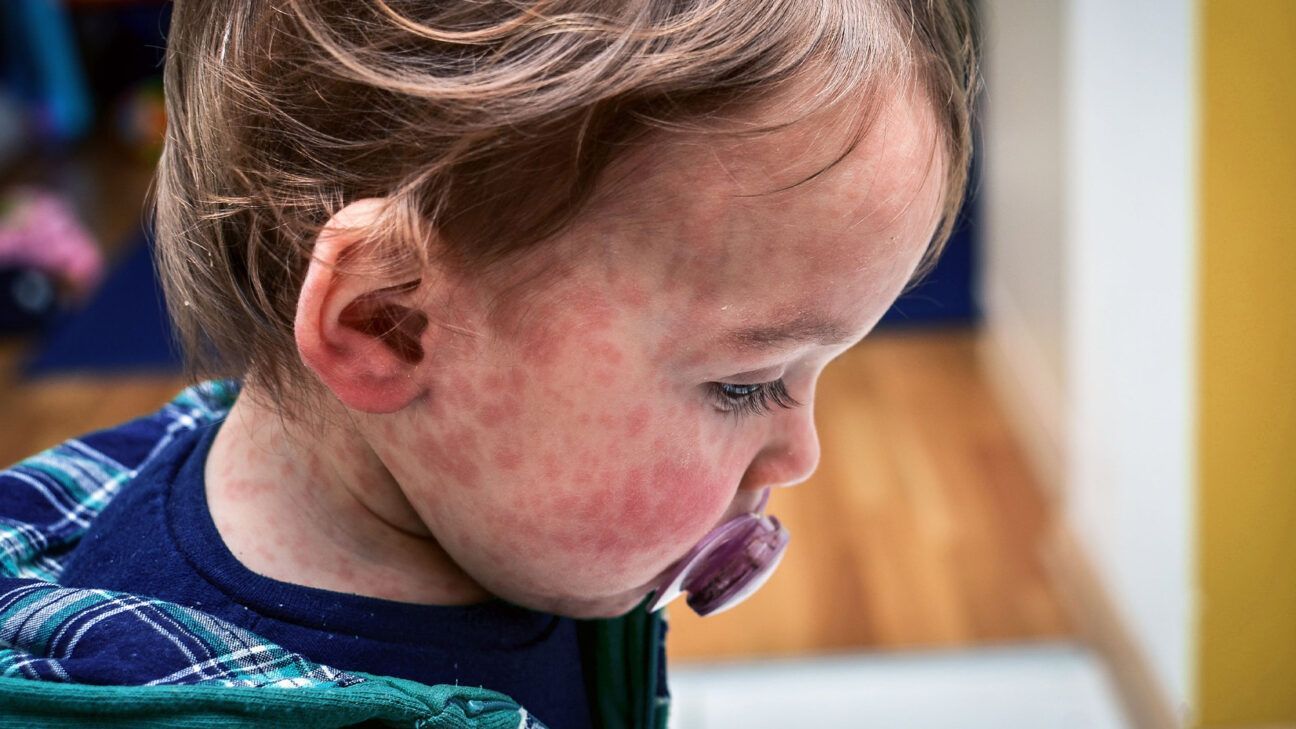
- Canada has lost its measles elimination status, which means the United States could soon follow suit.
- Rising measles cases in 43 U.S. jurisdictions among mostly unvaccinated individuals highlight declining childhood vaccination rates.
- A research projection estimates that if current trends continue, there could be as many as 51 million new measles cases in the U.S. in the next 25 years.
- Infectious disease experts remain concerned about the long-term impacts of vaccine hesitancy.
Rising measles cases in the United States underscore the impact of declining childhood vaccination rates, which have been on the rise in recent years.
As of November 12,
According to the CDC,
This year has seen the highest number of measles cases since
On November 10, the Pan American Health Organization (PAHO) announced that the Region of the Americas lost its verification as being free from endemic measles transmission after Canada lost its measles-free status. A country loses its measles elimination status once transmission has occurred for 12 consecutive months.
Measles was declared eliminated at the turn of the century. Now, according to experts, the United States could soon lose its elimination status, much like Canada has done under similar circumstances.
“Before we had the vaccine, measles killed
“The facts are clear — the measles vaccine is safe and effective,” Schaffner told Healthline.
Researchers had already warned that measles could make a significant comeback.
A recent study estimated that up to 51 million new measles cases could occur in the next 25 years if vaccination rates were to fall below 50%.
The projection, published in April in
Even with a 10% decline in vaccination rates, the researchers project upward of 11 million cases over the next 25 years.
The research model also forecasted the return of other infectious diseases, such as polio and diphtheria.
Measles is
“Measles is in the midst of a substantial resurgence in the United States at the present time,” Schaffner said.
Healthline spoke with Schaffner about the possibility of the United States losing its elimination status and what can be done to help reverse current trends. This is an edited and condensed version of that conversation
Could the JAMA study projections become a reality?
Schaffner: I think it’s a worst-case scenario. It’s possible, but it won’t get that bad.
That said, there are many communities in which vaccination rates have drifted down to 90% or even lower. In some communities, they’re very low, and we could continue to have outbreaks in those communities.
This is now a very prolonged, even accelerating outbreak because there has been a very large community that is under-vaccinated.
So yes, we could lose our elimination status, but I don’t think it will be as bad as this worst-case scenario suggests. That is not to say I don’t think it’s awful — it is definitely alarming.
What will happen if measles becomes endemic?
Schaffner: What we are seeing now will be expanded, namely clusters of measles around the country, as the virus is reintroduced into those communities where there is a very low vaccination rate, and then you’ll get bursts of measles in that community.
Fortunately, previous measles infection and vaccination provide very secure protection.
Relatively few people who’ve been previously vaccinated will become infected. So, we will have barriers of previously vaccinated folks and older people who were infected with the virus, which will confine measles to those who are under-vaccinated.
Could we learn to live with measles, like we have with COVID?
Schaffner: I hesitate to say that we would have to learn to live with it, because that’s a profoundly sad prospect.
The short answer is yes, and it will continue to occur in bursts because there will be many communities in the United States where vaccination levels will remain very, very high, well above 90%. That’s because those are communities where parents will conform to ‘no shots, no school’ policies, and you will get very high vaccination levels, as we have had in the past.
However, there are communities sometimes defined by a social phenomenon or a religious affiliation, for example, where vaccination rates are very low in that localized community.
One of the consequences of having these pockets of susceptible children is that when the virus enters those populations, the children will tend to be older than they were in the bad old days when they got measles, because they’ve been protected. They’ve had to wait for the virus to be introduced.
And you’ll have many more adolescents, for example, who’ve never experienced measles.
Complications occur at any age, but the older you are when you acquire measles, for example, if you’re a teenager, as many of these children are now who are acquiring infection in West Texas, the more likely you are to develop one of the complications.
Could other eliminated diseases make a comeback?
Schaffner: Everything depends on how broadly parents withhold their children from vaccination. Some parents are very selective, withholding only this or that vaccine; others withhold their children from all vaccines.
The broader the withholding, the more likely it is that one of these viruses will be reintroduced into the United States among susceptible persons.
As you know, we had a big polio scare in the suburbs of New York a few years ago, and we had one paralytic case in a young adult male who had never been vaccinated — and that poliovirus had been introduced from abroad.
So, these other illnesses that are contagious but not as contagious as measles will also be reintroduced into the United States.
Measles is at the forefront because it is the most contagious and easily transmitted. These others may take longer to appear in the United States because they are less contagious.
What can be done to reverse this trend?
Schaffner: Reality has tempered my optimism recently. It will take time to reach out to all of these populations to provide them with information and reassurance that vaccination is in the best interest of not only those individual children or your children, but also your entire community.
There are increasingly more children, adolescents, and adults living among us who are immunosuppressed, whether because of an illness or because they’re receiving immunosuppressive medication to treat an illness. These individuals cannot receive the measles vaccine because it contains a live, attenuated virus, and their immune system can’t fight off this virus.
We can protect them by having all the rest vaccinated and protected, making it very hard for the virus to get past us to them. We have a responsibility not only to our children but also to those who are more frail who live among us.
If you have any concerns, please talk to your doctor or your children’s doctor. They will be ready to talk with you about this and provide reassurance.
We have to do this at the local level and try to influence those individual communities to, over time, change people’s attitudes and feelings and make them more welcoming to vaccines. It’s a large task.