













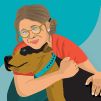

Textile artist Jeanne Hewell-Chambers shares how trust, advocacy, and quirky support turned her fears about a wet AMD clinical trial into stable vision and reclaimed independence.
Jeanne Hewell-Chambers is a textile artist, professional storyteller, and lifelong caregiver who learned in 2019 that she had wet age-related macular degeneration (AMD).
Wet AMD is a progressive condition in which blood vessels grow under the retina and leak blood or other fluids, which damages the macula in the eye. It can cause blurriness, blank spots, and other changes in central vision.
Jeanne described the onset of her symptoms in the 2019 entry of her blog: “I begin to need more light, more contrast. Then there is not enough light or contrast or magnification. I cannot read emails, magazines, menus, road signs. I notice that things seem to bend. Hard, immovable things like trees and boards on the back of trucks.”
Jeanne thought she might have cataracts, but scans of her left eye revealed blood, a sign of wet AMD.
Her ophthalmologist referred her to a retina specialist, who confirmed the diagnosis of wet AMD and recommended a clinical trial to treat it. Participants in the clinical trial would receive injections of anti-vascular endothelial growth factor (VEGF) medication into the eye. The goal was to slow or stop the growth of abnormal blood vessels.
“I went from knowing nothing about wet AMD to knowing nothing about pharmaceuticals going into my eye by a needle! So, there was a lot of soul searching about trust that had to go on there,” Jeanne told Healthline.
“I did some research. I married into a family of engineers and physicians, so I called on their brains, and they shook their trees, and mostly it was, ‘yes, this is a good thing to do.'”
Jeanne decided to enroll in the trial and began attending monthly clinic appointments to get injections.
When Jeanne began attending the clinic for treatment, she was first asked to sit in a room with other clinical trial participants. As a self-described introvert, she found that uncomfortable. “It was like a fish bowl,” she said.
She had to work with her clinical trial team to develop a treatment-day process that was comfortable for her. Over the years of caring for family members, she had learned to advocate for the needs of loved ones. Now she was learning to speak up for her own needs.
“There’s no need to go into that nerve-wracking event not feeling supported and surrounded by kindness, but you have to ask for it. People can’t read your soul, so you have to speak up. I had that skill for others, but not so much for me, until this,” Jeanne said.
A member of her clinical trial team began to welcome her at the clinic door before leading her into a private exam room to prepare for treatment.
“They would put a Q-tip with numbing agent in the corner of my eye, so my eye relaxed,” Jeanne said, “and then I sat there and did some meditation and breathing that kept me calm, kept me positive, and kept me in the chair.”
When her eye was numb, the eye doctor would come in to give her the injection.
Members of the clinical trial team would then keep her company until she was ready to go.
“The women on my clinical trial team were so supportive, and the camaraderie was great,” Jeanne said. “The lights were soft as I came back to where I needed to be; they took their time letting my eyes settle down, and stories were told. We kept up with babies and children’s graduations and vacations, just like friends did.”
The treatment made her eye more sensitive to light for several hours afterwards, so a member of her clinical trial team would fashion her an eye patch out of gauze to protect her eye from sunlight before she left.
Support from friends and family helped Jeanne manage the challenges of treatment.
One friend’s mother, Virginia, had been living with AMD for years. She was a “wealth of information,” Jeanne said. She shared her post-treatment recovery routine, which involved several days of rest. “She just rests, she lies still, she naps at will. And she also got a hat.”
Virginia inspired Jeanne to get her own treatment day hat. It had a wide brim, which helped keep sunlight out of Jeanne’s sensitive eye. It also had a “great big flower” that Jeanne had attached to it, to make her smile.
Another friend would “get lit” for Jeanne on treatment days. “She had this assortment of quirky candles, and she would light them all, send me a picture, and then wait for me to say, ‘It’s done. I’m fine,’” said Jeanne.
Jeanne’s husband would drive her home from each treatment, and they would grab something to eat, of her choosing. “I was like Queen of the Day,” she said.
Jeanne also used social media to connect with other people living with wet AMD. “From the get-go, I was out there asking real people who are dealing with this: ‘What did you do? What helps you get through?’ And also, ‘If anybody’s just been diagnosed, hop on! Let’s go through this together.’”
Jeanne described the support she received from others as “an energetic quilt” wrapped around her, helping her feel “safe” and “hopeful.”
After the first leg of the clinical trial concluded, Jeanne signed up for another to continue receiving treatment. She also staged a “graduation” ceremony in her retina specialist’s office to mark the occasion.
“To make it through this multi-year leg of a clinical trial, recommended by a man I didn’t know, with a treatment I didn’t know, where I’m saying, ‘OK, just put some in my eye and see what happens’? It took a lot of trust, and I had trusted that and come out successfully, so it seemed worthy of acknowledgement,” she said.
A few months into the second leg of the trial, tests showed no signs of active disease in Jeanne’s eye. The wet AMD had gone into remission, meaning fluid was no longer leaking into her eye. Her vision had stabilized.
Jeanne still gets regular eye checkups, but she hasn’t needed injections in over a year.
Although getting treatment was scary, she credits it with helping her maintain her independence.
She had not been able to pass a driver’s license eye exam before the clinical trial, but with the injections and corrective lenses, her eyesight has improved to the point where she can drive again while continuing other pursuits that matter to her.
“I’m still making art. I’m still writing. Yeah, I need bigger fonts on the screen, but that doesn’t bother me. I’m still doing, and changing, and reclaiming and revitalizing myself.”
“It is scary, it is serious, and you do have to take care of yourself — if you’re like me, in ways you never have before. But you can still live!” Jeanne said.
For other people who feel nervous about getting treatment, Jeanne recommends:
- reaching out to loved ones for support
- finding a doctor you trust, which sometimes involves changing doctors
- speaking up if you feel uncomfortable or your needs aren’t being met
Also, “get a hat,” she said. “A fancy hat. One that makes you smile.”
Jeanne Hewell-Chambers is a Southern family woman, professional storyteller, textile artist, and founder of The 70273 Project — an international collaborative art project that commemorates the 70,273 people with disabilities murdered by Nazis between 1940 and 1941. She shares stories about her art and life on her blog, The Barefoot Heart.