Key takeaways
- Kisqali is typically taken for 21 days within a 28-day cycle, followed by a 7-day break, and this schedule continues long-term if the treatment is effective and well-tolerated.
- The standard dose for Kisqali will depend on what it’s being used to treat, and it’s recommended to take it in the morning to potentially reduce sleep-related side effects.
- Kisqali is often prescribed alongside other medications like Faslodex or aromatase inhibitors, which may have their own dosing schedules that continue even on days Kisqali is not taken.
Kisqali is a type of targeted therapy for breast cancer, used in adults to treat hormone receptor-positive, HER2-negative breast cancer that’s advanced or metastatic. It can also be used in adults to treat HR-positive, HER2-negative early breast cancer (stage II or III) that’s at a high risk of coming back.
It’s usually taken with either Faslodex (fulvestrant) or an aromatase inhibitor, such as Femara (letrozole).
The active ingredient in Kisqali is called ribociclib. It’s usually taken in 28-day cycles. This article describes the dosages of Kisqali, as well as its strength and how to take the drug. To learn more about Kisqali, see this in-depth article.
Note: This article covers Kisqali’s typical dosages, which are provided by the drug’s manufacturer. But when using Kisqali, always take the dosage that your doctor prescribes.
The information described below covers common dosages of Kisqali. Your doctor will discuss your exact dosage and other details about Kisqali use for your condition.
What is Kisqali’s form and strength?
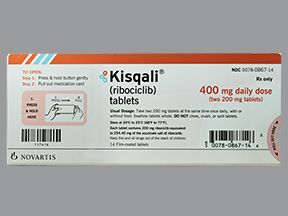
Kisqali comes as tablets that you swallow. It only comes in one strength of 200 milligrams (mg).
What are the typical dosages of Kisqali?
Below are commonly prescribed dosages of Kisqali. But be sure to take the dosage your doctor prescribes for you. Your doctor will determine the best dosage for you.
Kisqali treatment for certain kinds of breast cancer is based on a 28-day cycle. For early stage breast cancer, you’ll take 400 mg orally (two 200 mg tablets) once daily for 21 consecutive days, followed by 7 days off treatment.
For advanced or metastatic breast cancer, you’ll take 600 mg of Kisqali (three tablets) once each day for 21 days. Then you’ll stop taking the drug for 7 days. You’ll continue this dosing schedule as long as Kisqali is working safely and effectively for you.
If you’re taking an aromatase inhibitor with Kisqali, you’ll usually take it once daily throughout Kisqali treatment. This includes on days you don’t take Kisqali. An example of an aromatase inhibitor is Femara (letrozole).
Your doctor may prescribe the Kisqali Femara co-pack if you take Femara with Kisqali. The co-pack contains enough Kisqali and Femara tablets for one cycle.
If you’re taking Kisqali with Faslodex (fulvestrant), you’ll receive injections of Faslodex on days 1, 15, and 29 of the first month of treatment. (A healthcare professional will give you this drug as an injection into a muscle.) After this, you’ll receive these injections once monthly as long as your doctor determines they’re safe and working for your condition.
Is Kisqali used long term?
Yes, Kisqali is typically used as a long-term treatment. If you and your doctor determine that Kisqali is safe and effective for you, it’s likely that you’ll use it long term.
Dosage adjustments
You may need a dose reduction if you have certain serious health conditions, such as liver disease.
If you experience serious side effects with Kisqali, your doctor may lower your dose or pause treatment. Depending on your response, you may restart treatment or permanently stop taking Kisqali. For information about Kisqali’s side effects, see this article.
The dosage of Kisqali you’re prescribed may depend on several factors. These include:
- the severity of any side effects you have
- other medications you may be taking
- other conditions you may have, such as heart disease, lung disease, or liver problems
Kisqali is a tablet that you swallow whole. You’ll take a dose once daily for 21 days each month, then you’ll stop taking Kisqali for 7 days. (This 28-day period is called a cycle.)
You can take Kisqali with or without food. But try to take your dose at about the same time daily. The manufacturer recommends taking Kisqali in the morning.
Don’t crush, break, or chew Kisqali tablets. If you have trouble swallowing tablets, see this article for tips on how to take this form of medication.
It’s important to take Kisqali as prescribed to manage your condition. If you forget to take your usual dose of the drug, skip the missed dose. Continue with your next normally scheduled dose.
Don’t take two doses of Kisqali together. This may increase your risk of serious side effects.
If you need help remembering to take your dose of Kisqali on time, try using a medication reminder. This can include setting an alarm or using a timer. You could also download a reminder app on your phone.
Below are answers to some commonly asked questions about Kisqali’s dosage.
Why does my doctor recommend taking Kisqali in the morning?
Your doctor is following advice from the manufacturer of Kisqali, which recommends taking the drug in the morning. But the manufacturer doesn’t give a reason for this recommendation.
Note that a possible side effect of Kisqali is difficulty sleeping. Taking Kisqali in the morning (or when you start your day if that’s at another time) may help prevent this side effect.
To learn more about the right time for you to take Kisqali, talk with your doctor or pharmacist.
How long does it take for Kisqali to work?
Kisqali works by slowing down the growth and spread of breast cancer. It starts to work as soon as you begin taking it. But you may not notice the drug is working as it should.
To ensure Kisqali is working, your doctor will order certain tests during your treatment.
For more information about how long Kisqali takes to work, talk with your doctor or pharmacist.
Don’t take more Kisqali than your doctor prescribes. Taking more than this can lead to serious side effects.
Call your doctor right away if you think you’ve used too much Kisqali. You can also call 800-222-1222 to reach America’s Poison Centers, or use its online resource. But if you have severe symptoms, immediately call 911 (or your local emergency number) or go to the nearest emergency room.
Kisqali’s dosage generally depends on what it’s being used for. For early stage breast cancer, you’ll take 400 mg once daily for 21 consecutive days, followed by 7 days off treatment.
For advanced or metastatic breast cancer, you’ll take 600 mg of Kisqali once each day for 21 days. Then you’ll stop taking the drug for 7 days. You’ll continue this dosing schedule as long as Kisqali is working safely and effectively for you.
These dosages are recommended by the manufacturer, but your doctor may adjust your dosage according to your individual situation. If you have any questions about your dosage, reach out to your doctor.
Disclaimer: While Healthline strives for factual, comprehensive, and current information, this article is not a substitute for a licensed healthcare professional’s expertise. Always consult a doctor before taking or discontinuing any medication. Drug information is subject to change and may not cover all uses, directions, precautions, warnings, interactions, reactions, or adverse effects. The lack of a warning does not guarantee a drug’s safety, effectiveness, or appropriateness for all patients or specific uses. Learn more about our approach to content integrity.