Key takeaways
- Tresiba is a long-acting insulin prescribed to manage blood sugar levels in adults and children over 1 year old with type 1 and type 2 diabetes.
- The appropriate Tresiba dosage varies depending on which type of diabetes you have, whether you’re already taking insulin, and other individual factors. A doctor will calculate your correct dosage and may adjust it over time.
- It’s important to follow your doctor’s instructions and seek immediate medical attention in case of an overdose, which can cause serious side effects like low potassium and low blood sugar.
Tresiba is a long-acting insulin that contains the active ingredient insulin degludec. Tresiba is given as an injection under your skin. Your doctor will show you how to give yourself these injections.
This article describes the dosages of Tresiba, including its forms, strengths, and how it’s administered.
Note: This article covers Tresiba’s typical dosages, which are provided by the drug’s manufacturer. Your doctor will determine the best dosage to fit your needs. Be sure to follow the dosage they prescribe for you.
Tresiba is available in different forms and strengths.
What are the forms of Tresiba?
Tresiba comes as a liquid solution in two forms:
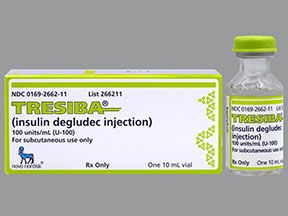
- multidose vials for use with syringes
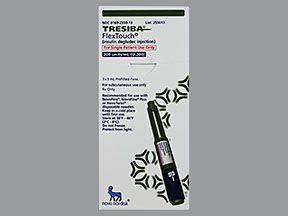
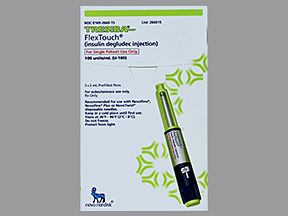
- single-use, prefilled injection pens, called FlexTouch pens
What strengths does Tresiba come in?
Tresiba multidose vials come in a 10-milliliter (mL) size in one strength: U-100 (100 units of insulin per mL of solution).
Tresiba FlexTouch pens come in a 3-mL size in two strengths: U-100 and U-200 (200 units of insulin per mL of solution).
What are the typical dosages of Tresiba?
Your doctor will likely start you on the dosage that’s recommended for treating your condition. Then they’ll adjust your dosage over time to reach the right amount for you. They’ll ultimately prescribe the smallest dosage that provides the desired effect. There isn’t a maximum recommended dose of Tresiba.
Your insulin dosage will be prescribed as a number of insulin units per day. If using Tresiba vials, you’ll remove the amount of insulin you’re prescribed from the vial using syringes. If you use Tresiba FlexTouch pens, you’ll select your FlexTouch dosage using a dial on the pen.
The following information describes dosages that are commonly used or recommended. Your doctor will determine the best dosage to fit your needs.
Dosing for type 1 diabetes
If you have type 1 diabetes, your doctor will determine your total daily insulin dose. This total daily dose is then divided into long-acting (or intermediate-acting) insulin and short-acting insulin. The usual total daily insulin dosage range is 0.2 to 0.4 units per kilogram (kg) of body weight. (For reference, 1 kg equals approximately 2.2 pounds [lb].)
Your starting dosage of Tresiba for type 1 diabetes will depend on whether you’re already using other forms of insulin. Your doctor will continue to adjust your dosage as needed until your blood sugar levels are within a healthy range.
| For type 1 diabetes | Recommended starting dose | When it’s injected |
|---|---|---|
| If you’re not already using insulin | one-third to one-half of the total amount of short-acting and long-acting insulin you’ll use each day* | once per day, any time of day |
| If you’re already using insulin | same as the total amount of intermediate-acting or long-acting insulin you’ve been using each day | once per day, any time of day |
* For example, if your doctor prescribes a total daily insulin dose of 50 units, your Tresiba dosage will be 17 units to 25 units each day.
Dosing for type 2 diabetes
Your starting dosage of Tresiba for type 2 diabetes will depend on whether you’re already using other forms of insulin. Your doctor will continue to adjust your dosage as needed until your blood sugar levels are within a healthy range.
| For type 1 diabetes | Recommended starting dose | When it’s injected |
|---|---|---|
| If you’re not already using insulin | 10 units | once per day, any time of day |
| If you’re already using insulin | same as the total amount of short-acting and long-acting insulin you’ve been using each day | once per day, any time of day |
What’s the dosage of Tresiba for children?
Tresiba is used to treat type 1 and type 2 diabetes in children ages 1 year and older. A child’s starting dosage of Tresiba will depend on whether they’re already using other forms of insulin. Their doctor will continue to adjust their dosage as needed until their blood sugar levels are within a healthy range.
The following dosage chart shows the recommended starting dosage and dosing schedule for children with type 1 and type 2 diabetes.
| Diabetes type | Recommended starting dose | When it’s injected |
|---|---|---|
| Type 1 | ||
| if the child isn’t already using insulin | one-third to one-half of the total amount of short-acting and long-acting insulin the child will use each day* | once per day, at the same time each day |
| if the child is already using insulin | 80% of the total amount of intermediate-acting or long-acting insulin the child has been using each day | once per day, at the same time each day |
| Type 2 | ||
| if the child isn’t already using insulin | 10 units | once per day, at the same time each day |
| if the child is already using insulin | 80% of the total amount of intermediate-acting or long-acting insulin the child has been using each day | once per day, at the same time each day |
* For example, if your child’s doctor prescribes a total daily insulin dose of 20 units, their Tresiba dosage will be 7 units to 10 units each day.
Is Tresiba used long term?
Yes, Tresiba is typically a long-term treatment. If you and your doctor determine that it’s safe and effective for you, you’ll likely use it long term.
Dosage adjustments
In some cases, your doctor may need to adjust your Tresiba dosage. This can happen because of changes in your physical activity or diet, or if you’re sick or experiencing stress.
If you have questions about changing your Tresiba dosage, talk with your doctor.
Do not inject more Tresiba than your doctor prescribes, as this can lead to serious side effects.
Symptoms of overdose
Symptoms caused by an overdose can include:
- low level of potassium in your blood, which can lead to constipation, heart palpitations, muscle cramps, and weakness
- severe hypoglycemia (low blood sugar), which can lead to confusion, dizziness, headache, and sweating
What to do in case you inject too much Tresiba
Call your doctor right away if you think you’ve injected too much Tresiba. You can also call 800-222-1222 to reach America’s Poison Centers or use its online resource. But if you have severe symptoms, immediately call 911 (or your local emergency number) or go to the nearest emergency room.
The dosage of Tresiba you’re prescribed may depend on several factors. These include:
- the type and severity of your diabetes
- your age
- your weight
- your blood sugar levels
- whether you’re already using other types of insulin
- your diet
- when or how much you exercise
- other conditions you may have (see “Dosage adjustments” in the “What is Tresiba’s dosage?” section)
Tresiba is injected under the skin of your arm, belly, or thigh. With each dose, be sure to rotate injection sites. This helps prevent problems such as lumpy, pitted, or thickened skin that can happen if the drug is injected into the same location over and over.
Your doctor will show you how to give yourself Tresiba injections. You can also watch a video with step-by-step instructions for using the FlexTouch pens on the manufacturer’s website. Or you can read Tresiba’s prescribing information.
If you forget to inject a dose of Tresiba, inject your missed dose as soon as you remember. Just make sure that each dose of Tresiba is separated by at least 8 hours.
You should not inject two doses at once or give yourself extra units of Tresiba to make up for a missed dose. Doing this could cause severe low blood sugar.
To help make sure you don’t miss a dose, try using a medication reminder such as a reminder app downloaded to your phone.
Below are answers to some commonly asked questions about Tresiba’s dosage.
Are the dosages the same for Tresiba and Lantus?
Tresiba and Lantus have some similarities, but their dosages may differ. Both drugs are long-acting insulins used to manage blood sugar levels in people with type 1 or type 2 diabetes. Tresiba contains the active drug insulin degludec, and Lantus contains the active drug insulin glargine.
Both drugs are typically injected under the skin once daily. But Tresiba’s effects can last for at least 42 hours, while Lantus works for up to 24 hours. For this reason, the exact dosage (number of insulin units) for each drug may be different.
For more information on how these drugs compare, see this Tresiba vs. Lantus comparison article.
Can Tresiba be used twice per day?
No, Tresiba should not be used twice per day. It should only be injected once daily. Tresiba is a long-acting insulin that helps regulate your blood sugar levels between meals and overnight.
The level of Tresiba in your body remains consistent throughout the day. Its effects can last for at least 42 hours after a single dose, so there’s no need to use Tresiba more than once daily.
If you have questions about when to inject Tresiba, talk with your doctor.
Could my Tresiba dosage be affected by other drugs that I’m taking?
Yes, other drugs you take could affect your Tresiba dosage.
Depending on the type of diabetes you have, you might take other diabetes drugs along with Tresiba. These other drugs work to lower your blood sugar in a different way than Tresiba does.
To help prevent episodes of severe low blood sugar, your dosage of Tresiba will likely be adjusted if you take other diabetes drugs.
Note: Other drugs may interact with Tresiba and affect your dosage. For more information, see this Tresiba interactions article.
Disclaimer: Healthline has made every effort to make certain that all information is factually correct, comprehensive, and up to date. However, this article should not be used as a substitute for the knowledge and expertise of a licensed healthcare professional. You should always consult your doctor or another healthcare professional before taking any medication. The drug information contained herein is subject to change and is not intended to cover all possible uses, directions, precautions, warnings, drug interactions, allergic reactions, or adverse effects. The absence of warnings or other information for a given drug does not indicate that the drug or drug combination is safe, effective, or appropriate for all patients or all specific uses.