














Yoga stretches may help decrease lower back pain. Some stretches you can practice include supine cat-cow, tabletop, and more.
Stretching your hips and strengthening the muscles in your abdomen and posterior chain can help you maintain proper posture while also keeping your intervertebral disks healthy. These are the jelly donut-like structures that sit between each vertebra and
A well-aligned spine also means that your entire nervous system can function effectively, helping to improve your overall well-being.
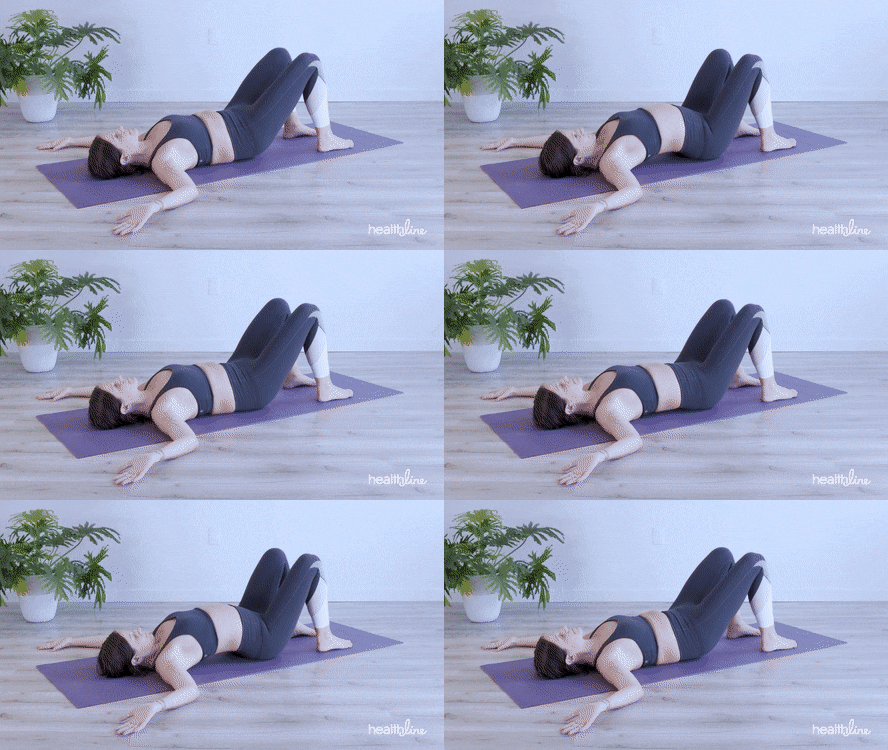
Doing cat-cow, specifically while lying on your back, helps to isolate the movements to the lumbar region (the lower spine).
Muscles strengthened: rectus abdominus, obliques, hip extensors, erector spinae, quandratus lumbroum, hip flexors
Muscles lengthened: spinal extensors, hip flexors, rectus abdominus, obliques, hip extensors
How to cat-cow
- Begin by lying on your back, with your knees bent. Your feet should be hip-width apart and your knees placed directly above your ankles.
- To do cow pose: On an inhale, extend your spine by directing your tailbone downward into the floor, allowing your lower back to arch away from the floor and stretching the front of your body.
- To do cat pose: On an exhale, flex your spine. Draw your tailbone toward the backs of your knees and allow your lower back to flatten out against the floor, while stretching the back of your body.
- Repeat these 5-10 times.
This core strengthening exercise helps to develop muscles in the front of the body and helps to improve posture.
Muscles strengthened: rectus abdominus, obliques, biceps, spinal extensors, hamstrings, glute maximus, triceps
Muscles lengthened: quadriceps, spinal extensors, hamstrings, biceps
How to do tabletop with alternating knee to elbow
- Start on all fours in a “table top” position. Stack your shoulders above your wrists and keep your hips level with or slightly above your knees. Align your sit bones with the wall behind you and keep your chest and gaze directed forward.
- On an inhale, reach your right arm forward and left leg back behind you, while supporting yourself with the front of your body.
- Exhale and touch your opposite knee to the opposite elbow, and round your back strongly by pressing your left hand into the floor.
- Inhale and return to the extended leg and arm position, keeping length from tail to crown.
- Exhale and place your limbs back down to the floor.
- Repeat on the left side. Practice 5 times, per side.
This standing pose is a great way to find length and space in the body. A contributor to lower back pain is tight hamstrings, which can result in what’s called a posterior tilt, or a rounded lower back.
Muscles strengthened: obliques, quadratus lumborum, spinal extensors, biceps
Muscles lengthened: hamstrings, pectoralis, triceps
How to do trikonasana
- Start by standing with your feet together. Inhale and extend your arms out to your sides in a T-shape position, then step your feet out until your ankles line up below your wrists.
- On an exhale, from deep within the hip socket, turn your right leg outward (externally) so that your right foot and knee point away from your body. Your back foot and hip should be angled slightly toward your front leg.
- On an inhale, reach through your right arm as you shift your front hip back, creating maximum length in your side body.
- Exhale and place your right hand down on the outside of your foot or outer shin. Your left arm should be directly above your shoulder, reaching strongly toward the sky.
- Stay here for 10 full breaths. To come out, inhale and raise your torso back to an upright and parallel position to your feet. Repeat on the left side.
The common postural habits of sitting and hunching forward (think looking at your phone or sitting at your desk) can cause the spine to round. The locust pose is designed to counteract this by developing the muscles on the back of your body, which is crucial for good posture.
You’ll also open your lungs, which will help to improve your breathing.
Muscles strengthened: hamstrings, glute maximus, spinal extensors
Muscles lengthened: hip flexors, rectus abdominus, pectarolis, biceps
How to do salabhasana (locust pose)
- Begin by lying on your stomach, with your arms by your sides and your palms facing your outer hips. Note: You can place a thin blanket underneath your pelvis if the floor is too hard.
- On an inhale, lift your whole body from the floor by raising your arms and legs up, and your chest and the crown of your head forward.
- Be careful not to overwork your glute maximus by over-lifting your inner legs. Your lower belly should gently pull away from the floor as you draw your tailbone toward the back of your knees.
- Remain in this position for 10 full breaths. Lower and repeat for a total of 3 rounds.
Not all lower back pain originates in the lumbar region, but instead occurs where the sacrum (the fused section of the spine beneath the lumbar) meets the pelvis. This is referred to as the sacroiliac joint, or SI joint.
SI pain has
Thread the needle is an accessible, but powerful shape that helps to release the outer hips and glutes.
Muscles strengthened: sartorius, hamstring
Muscles lengthened: glute maximus, glute minimus, piriformis, tensor fascia latae
How to thread the needle
- Start on your back with your knees bent, and feet and legs hip-width apart. Cross your right ankle over your left thigh to create a figure 4 shape. Note: You’re welcome to stay here if it’s hard to reach your legs.
- Reach your right arm through the opening (eye of the needle) and hold the front of your left shin.
- As you draw your legs toward your chest, keep your lumbar in its natural curve by lengthening your sit bones toward the front of the room.
- Your elbows should be slightly bent, and your upper back and head should remain on the floor. Hold this position for 25 breaths before switching sides.
Yoga can both help ease and prevent lower back pain. You can practice this simple sequence in the morning to get your day started or at night to help lengthen you out after a trying day.
Remember to consult your doctor before performing any new exercises or postures, especially if you have health conditions that may put you at high risk of injury.