Key takeaways
- Skyrizi is available in multiple forms, including single-dose prefilled pens and single-dose prefilled syringes.
- The typical dosages of Skyrizi may vary depending on which condition is being treated.
- For example, for Crohn’s disease, the usual starting dose of Skyrizi is 600 milligrams (mg), given as an IV infusion. This dose is given at weeks 0, 4, and 8. At week 12, you’ll start a maintenance dosage of 180 mg or 360 mg, given every 8 weeks.
Skyrizi is used in certain adults to treat:
- moderate to severe plaque psoriasis that can be treated with phototherapy or systemic therapy
- active (causing symptoms) psoriatic arthritis
- moderate to severe active Crohn’s disease
- moderate to severe ulcerative colitis
The active ingredient in Skyrizi is risankizumab-rzaa. (The reason “-rzaa” appears at the end of the drug’s name is to show that the drug is distinct from similar medications that may be created in the future.) It’s a biologic medication, which is a type of drug that’s made from parts of living organisms.
Skyrizi belongs to a group of drugs called interleukin-23 antagonists.
This article describes the dosage of Skyrizi, as well as its strengths and how to use the drug.
Your doctor will likely start you on a low dosage and adjust it over time to reach the right amount for you. They’ll ultimately prescribe the smallest dosage that provides the desired effect.
The drug’s dosages differ based on the condition being treated. Keep reading for more details about Skyrizi’s forms, strengths, and dosages.
What are the forms of Skyrizi?
Skyrizi comes as a liquid solution in the following forms:
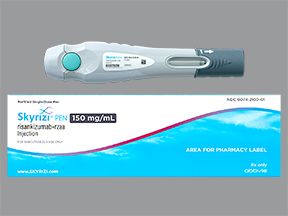
- single-dose prefilled pens
- single-dose prefilled syringes
- single-dose prefilled cartridges
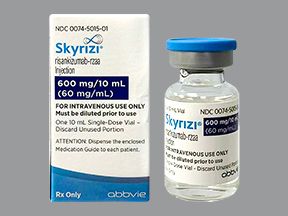
- single-dose vials
What strengths does Skyrizi come in?
Skyrizi is available in the following strengths, which differ based on the form of the drug you use.
| Skyrizi forms | Skyrizi strengths |
|---|---|
| single-dose prefilled syringe | • 90 mg/mL • 150 mg/mL • 180 mg/1.2 mL |
| single-dose prefilled pen | • 150 mg/mL |
| single-dose prefilled cartridge | • 180 mg per 1.2 mL (150 mg/mL) • 360 mg per 2.4 mL (150 mg/mL) |
| single-dose vial | • 600 mg per 10 mL (60 mg/mL) |
What is the typical dosage of Skyrizi?
The following information describes the commonly used or recommended Skyrizi starting dose, maintenance dose, and frequency of administration (how often you receive Skyrizi). In some cases, doctors may adjust your dosage from those shown here.
But be sure to follow the dosing instructions your doctor prescribes. They’ll determine the best dosage to fit your needs.
Dosage for plaque psoriasis
For adults with plaque psoriasis, the typical Skyrizi dosage is 150 mg, injected under the skin.
You’ll need to receive two starter doses, with the second starter dose 4 weeks after the first. After that, you’ll have a maintenance dosage of one dose every 12 weeks.
Talk with your doctor if you have questions about your dosage.
Dosage for psoriatic arthritis
The typical Skyrizi dosage for adults with psoriatic arthritis is 150 mg, injected under the skin.
You’ll need to receive two starter doses, with the second starter dose 4 weeks after the first. After that, you’ll have a maintenance dosage of one dose every 12 weeks.
To treat psoriatic arthritis, your doctor may prescribe Skyrizi alone or in combination with non-biologic disease-modifying antirheumatic drugs (DMARDs) such as methotrexate (Trexall).
To learn more about your specific dosage, talk with your doctor.
Dosage for Crohn’s disease
For adults with Crohn’s disease, the typical Skyrizi starting dose is 600 mg, given as an IV infusion.
You’ll need to receive three starter doses, with doses at weeks 0, 4 and 8. At week 12, you’ll have a maintenance dosage of 180 mg or 360 mg every 8 weeks, injected under your skin.
Your doctor will prescribe the lowest maintenance dosage needed to effectively treat your condition.
For information about your specific dosage, talk with your doctor.
Dosage for ulcerative colitis
The typical Skyrizi dosage to treat adults with ulcerative colitis is 1,200 mg, given as an IV infusion.
You’ll need to receive three starter doses, with doses at weeks 0, 4, and 8. At week 12, you’ll have a maintenance dosage of 180 mg or 360 mg every 8 weeks, injected under your skin.
Your doctor will prescribe the lowest maintenance dosage needed to effectively treat your condition.
You can ask your doctor any questions you have about your dosage.
Is Skyrizi used long term?
Yes, Skyrizi is typically used as a long-term treatment. If you and your doctor determine that Skyrizi is safe and effective for you, it’s likely that you’ll use it long term.
Your starting doses of Skyrizi will be given by your doctor or another healthcare professional. After this, you can self-inject maintenance doses at home. Your doctor can show you how to do this.
If you receive starting doses as an injection under your skin, they’ll be given using a prefilled syringe or pen. The injection can be given into your abdomen, the front of your thigh, or the back of your upper arm.
If your starting doses are given as an IV infusion, a healthcare professional will use a prefilled vial to prepare the infusion.
Skyrizi maintenance doses are given as an injection under your skin.
If you miss a dose of Skyrizi, take it as soon as you remember, then resume with your regular schedule.
Let your doctor know that you missed your dose. If it’s been more than a few days after you were supposed to take your dose, contact your doctor. They can let you know how to get back on schedule.
If you need help remembering to inject Skyrizi on time, try using a medication reminder. This can include setting an alarm or using a timer. You could also download a reminder app on your phone.
Do not use more Skyrizi than your doctor prescribes. Using more than this can lead to serious side effects.
What to do in case you use too much Skyrizi
Call your doctor right away if you think you’ve used too much Skyrizi. You can also call 800-222-1222 to reach America’s Poison Centers, or use its online resource. But if you have severe symptoms, call 911 (or your local emergency number) immediately or go to the nearest emergency room.
Disclaimer: While Healthline strives for factual, comprehensive, and current information, this article is not a substitute for a licensed healthcare professional’s expertise. Always consult a doctor before taking or discontinuing any medication. Drug information is subject to change and may not cover all uses, directions, precautions, warnings, interactions, reactions, or adverse effects. The lack of a warning does not guarantee a drug’s safety, effectiveness, or appropriateness for all patients or specific uses. Learn more about our approach to content integrity.